Frequently asked questions and useful links

Answers to common queries about the Flinders Ranges World Heritage bid, and informative external links.
This page will help you:
- discover more details about World Heritage
- find out who's behind the nomination and the decision
- link to more useful online resources.
World Heritage sites are unique and exceptional places around the world, recognised by the United Nations Educational, Scientific and Cultural Organisation (UNESCO) for their internationally significant natural and/or cultural values.
Sites are added to the World Heritage List when a country that is signatory to the World Heritage Convention - such as Australia - nominates a place that is then formally accepted by UNESCO.
Australia currently has 21 World Heritage sites, including Uluru–Kata Tjuta National Park, the Great Barrier Reef, Kakadu National Park and Fraser Island.
South Australia currently has one World heritage site, the Naracoorte Caves, which are jointly listed with Riversleigh in Queensland as 'Australia’s Fossil Mammal Sites'.
World Heritage listing is coordinated by UNESCO through the World Heritage Centre.
Nominations are assessed to determine whether a proposed site demonstrates Outstanding Universal Value (OUV) against strict criteria. Outstanding Universal Value is the core concept of the UNESCO World Heritage Convention, defining cultural or natural sites as having exceptional, transnational significance that is important for all humanity, requiring permanent protection for present and future generations.
The final decision is made by the UNESCO World Heritage Committee, which meets once a year.
World Heritage sites in Australia are primarily protected and managed under the Environment Protection and Biodiversity Conservation Act 1999 (EPBC Act). This legislation allows the Australian Government to regulate activities within declared World Heritage sites.
Any action likely to significantly impact a site’s World Heritage values - such as construction, resource exploration or extraction, hazardous material storage or transport, waste disposal, or earthworks - must undergo environmental assessment and receive approval under the EPBC Act.
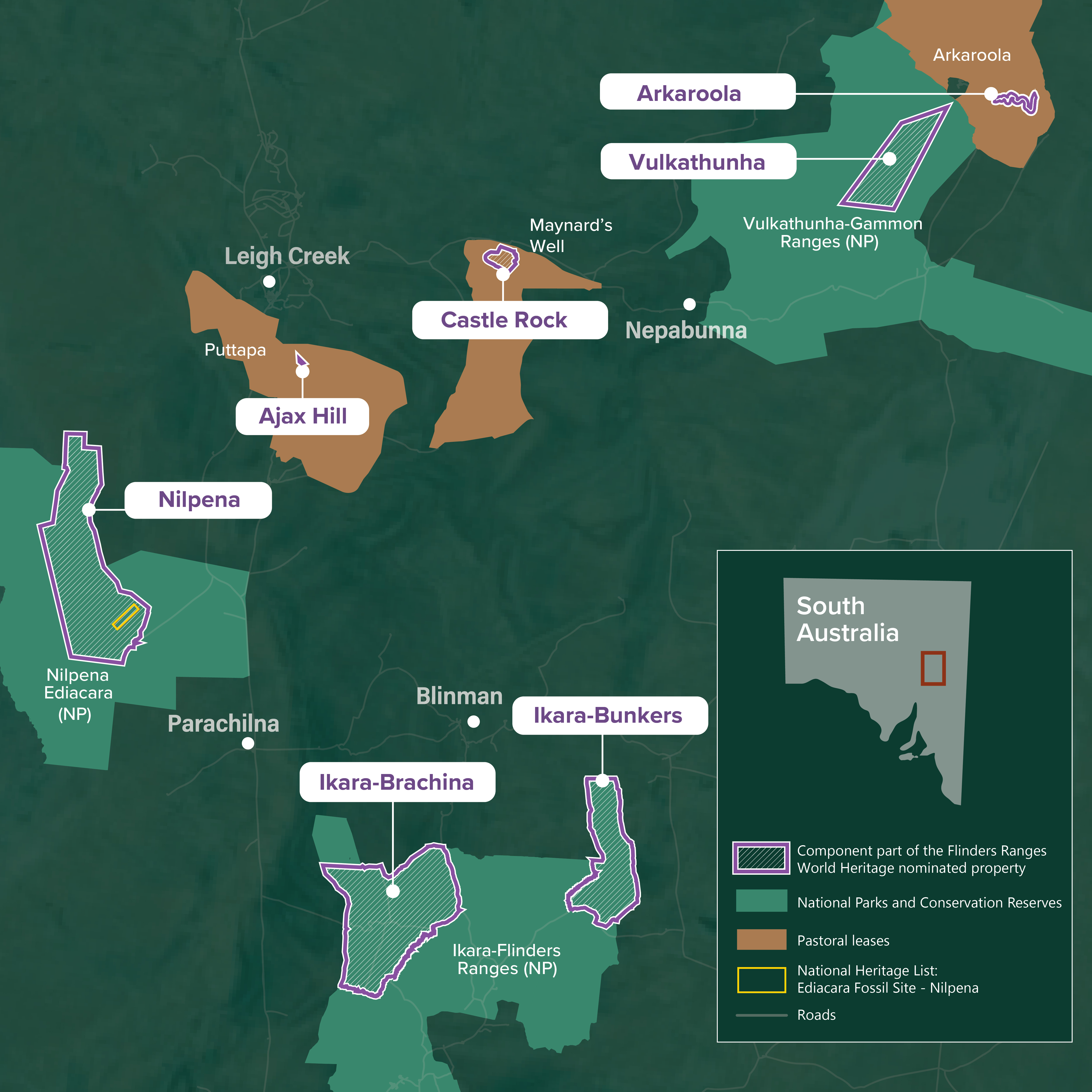
The World Heritage bid for the Flinders Ranges is known as a 'serial nomination', meaning it is made up of a number of separate sites (known as 'component parts') that together tell the World Heritage story of the rise of animal life.
Seven sites are included in the proposed nomination, spanning a large area with mixed land uses, including co-managed national parks, private pastoral land, conservation parks and protected areas.
These proposed sites include locations within:
- Ikara–Flinders Ranges National Park
- Vulkathunha–Gammon Ranges National Park
- Nilpena Ediacara National Park
- Arkaroola Protection Area
- Maynards Well pastoral lease
- Puttapa pastoral lease
- The newly acquired Balcoracana paddock, that will be incorporated into Ikara-Flinders Ranges National Park and be part of the Ikara-Bunkers World Heritage component part.

Visitors can experience the key World Heritage values at three main destinations:
- Nilpena Ediacara National Park - home to a world-class Ediacara fossil experience, opened to visitors in April 2023.
- Brachina Gorge in Ikara–Flinders Ranges National Park - featuring the redeveloped 20 km Brachina Gorge Geological Trail, which reveals 130 million years of Earth’s history.
- Arkaroola - a long-established conservation and research area that attracts visitors from around the world and offers established geological tours.
Visitor access to privately owned land is subject to prior agreement with landholders, issued on a case-by-case basis. World Heritage sites are not required to be accessible to the public.
World Heritage listing does not alter land ownership or control. Existing ownership and state and local laws remain unchanged. World Heritage sites do not become Commonwealth property, nor do they transfer to any international organisation or foreign authority.
Most existing land use – such as pastoralism and tourism – can continue after listing. If any existing activities are identified as potentially impacting the World Heritage values, these would be discussed with landholders before a nomination proceeds.
Participation in the nomination is voluntary, and properties have only been included with the agreement of landholders.
A World Heritage Advisory Committee, with an independent chair, will oversee the management of the World Heritage property, bringing together landholders, Traditional Owners, tourism, and researchers.
Yes, scientific research is supported and will continue to be permitted within World Heritage areas, subject to the normal approvals and/or landholder permissions.
Further information on how to apply for research approval within a World Heritage area will be provided as the nomination progresses.
If you have a question, please contact us at DEWResearchPermits@sa.gov.au or on (+61 8) 8124 4856.
The South Australian Government has led the process to prepare the nomination, in collaboration with the Australian Department for Climate Change, Energy, the Environment and Water, Adnyamathanha people and the local community.
Three leading scientific experts have been playing key roles in the preparation of the Flinders Ranges World Heritage nomination dossier:
- Professor Glenn Brock, Associate Professor of Palaeobiology at Macquarie University in Sydney
- Distinguished Professor Mary Droser, Professor of Palaeontology at University of California, Riverside
- Stephen Hore, Senior Geologist with the Geological Survey of South Australia, Department for Energy and Mining.
The World Heritage Committee's position is clear: mineral, oil and gas exploration or exploitation is incompatible with World Heritage status and should not occur within World Heritage properties.
There are no existing mines within the component parts, and none nearby that impact upon the elements that demonstrate Outstanding Universal Value within the proposed component parts.
More questions? Contact us
Department for Environment and Water
Email: dew.frwh@sa.gov.au

Flinders Ranges World Heritage Postcards
You can collect free limited edition Flinders Ranges World Heritage postcards to send to family and friends. They are available at the Department for Environment and Water, Customer Service Centre (Ground floor, 81-95 Waymouth Street, Adelaide SA 5000) or at visitor centres, tourism destinations and businesses throughout the Flinders Ranges.